In my previous post, Chinese vs. Western Fantasy: What Questions Does the Afterlife Ask?, I explored how different fantasy traditions approach the afterlife.
This time, I want to look at what happens when we turn our attention from the dead to the divine.
When we imagine a pantheon, what kind of society do we imagine it to be?
A family of gods ruling from a heavenly court? A hierarchy of divine beings, each with their own territory and authority? Or a vast supernatural bureaucracy, where gods hold offices, receive appointments, and carry out duties within an established system?
These images are not merely different ways of arranging supernatural characters. They reflect different ways of imagining authority itself.
1. Pantheon Hierarchy vs. Bureaucratic Hierarchy
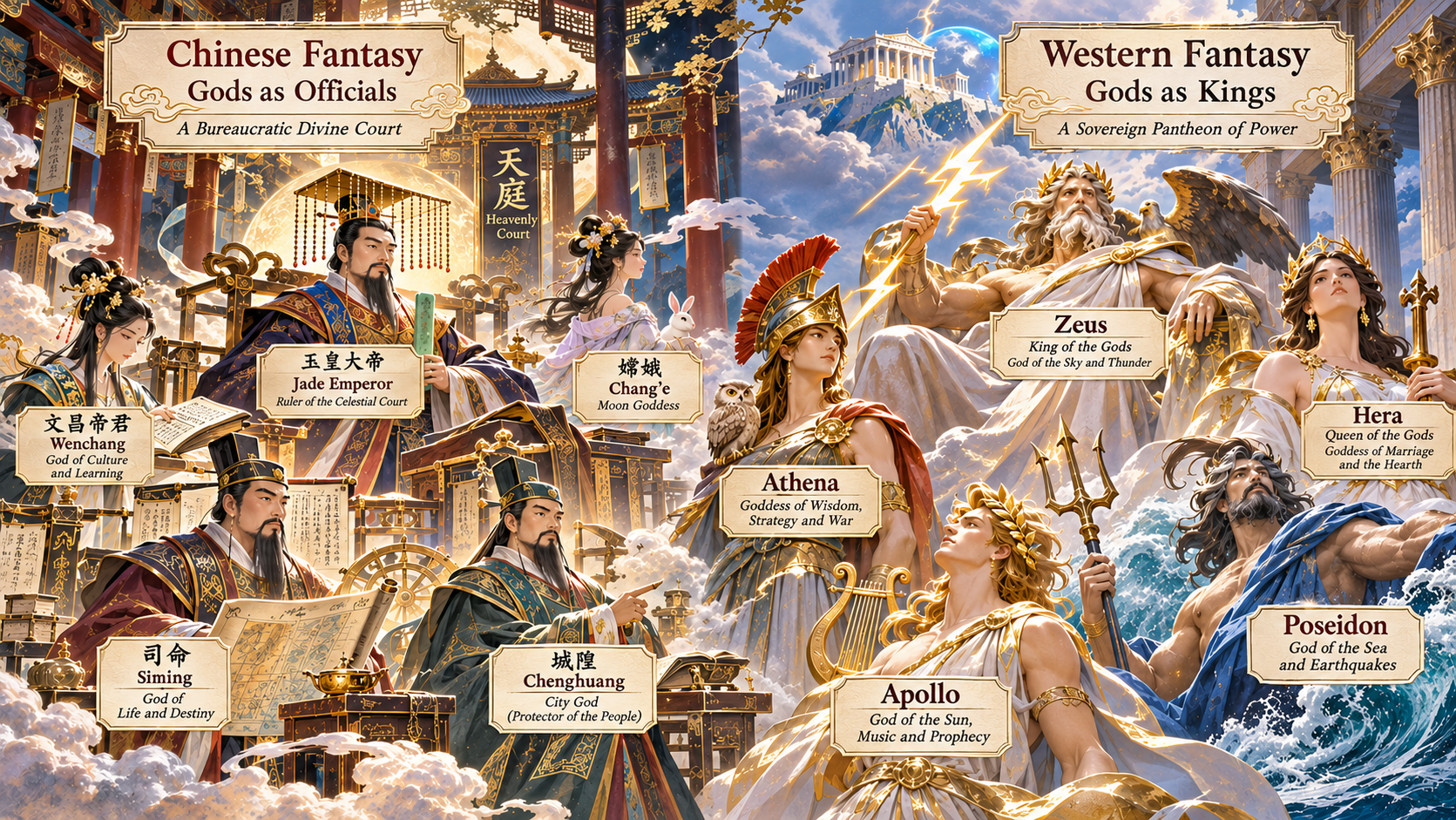
In much of Western fantasy inspired by Greek, Norse, or other mythological traditions, the divine world is often imagined as a hierarchy of powerful beings.
At its centre may be a supreme god, a divine king, or a ruling family. Other gods possess their own domains and powers, but their relationships with one another are frequently shaped by kinship, rivalry, alliances, inheritance, and personal authority.
The divine order resembles a royal court.
Power belongs to individuals. A god may rule because of their birth, their strength, their status, or their ability to command the loyalty of others. The hierarchy can be challenged through rebellion, succession disputes, or conflicts between members of the divine family.
Chinese fantasy often offers a different image.
The heavenly realm may resemble an imperial administration. Gods and immortals occupy offices, oversee particular functions, and operate within a hierarchy of appointments and responsibilities. The supernatural world can contain departments, jurisdictions, records, regulations, and chains of command.
A deity is not necessarily powerful simply because they are an ancient or extraordinary being. Their position within the celestial order may matter just as much.
This creates an interesting distinction.
A divine king commands because they are the ruler.
A divine official exercises authority because they occupy an office within a larger system.
Of course, these are broad tendencies rather than absolute rules. Western mythology also contains divine councils and complex hierarchies, while Chinese mythology includes powerful independent beings who stand outside, resist, or challenge the heavenly administration.
Nevertheless, the contrast is useful because it reveals two different ways of organising the supernatural.
One places emphasis on the relationships between powerful individuals.
The other places emphasis on the structure through which power is distributed.
2. Divine Authority vs. Administrative Authority
The difference becomes more interesting when we ask a second question:
Where does a god’s authority come from?
In a divine monarchy, authority may be personal.
A god rules because they possess extraordinary power, because they belong to the ruling family, or because they have established their position through conquest and conflict.
Their authority is closely tied to their identity.
If the ruler falls, the entire hierarchy may be thrown into crisis. A new ruler must establish their legitimacy, defeat rivals, or secure recognition from the other gods.
In a bureaucratic divine order, authority can be more impersonal.
A god may possess a particular office and exercise the powers associated with it. Their authority is connected to the position they hold, the jurisdiction assigned to them, and the system that recognises their appointment.
This creates a different kind of supernatural conflict.
A character may be powerful enough to defeat a celestial official in combat, yet still lack the authority to alter the official’s decision.
They may be able to destroy a messenger, but not invalidate the decree the messenger carries.
They may be able to escape the jurisdiction of one department, only to find themselves subject to another.
In such a world, power is not always the same as authority.
And authority is not always the same as justice.
A celestial official may faithfully enforce an unjust rule. A higher-ranking deity may issue an order that harms the very people the official is supposed to protect. A protagonist may discover that the problem is not a corrupt individual, but a system whose procedures produce harmful outcomes.
This is a particularly fertile source of conflict for fantasy.
The antagonist does not always need to be a tyrannical god. Sometimes the antagonist is an institution that continues to function exactly as designed.
3. What Kind of Conflicts Does Each Model Produce?
These two models naturally suggest different kinds of stories.
In a divine court organised around kingship and personal power, conflicts may revolve around:
- Succession and inheritance
- Rivalries between gods
- Alliances and betrayals
- Challenges to a ruler’s legitimacy
- The consequences of divine pride, ambition, or vengeance
The central question may be:
Who has the right to rule?
In a divine bureaucracy, conflicts may instead revolve around:
- Disputes over jurisdiction
- Conflicting duties between departments
- Improper appointments or revoked titles
- Records that determine a soul’s fate
- Regulations that cannot account for exceptional circumstances
- Officials who must choose between obedience and responsibility
The central question may become:
Who has the authority to make this decision, and what happens when the system gets it wrong?
Neither model is inherently more sophisticated than the other. They simply create different pressures on the characters and different possibilities for the story.
A divine monarchy is well suited to stories about legitimacy, ambition, and the personal cost of power.
A divine bureaucracy is particularly suited to stories about procedure, responsibility, and the tension between individual circumstances and institutional rules.
And, of course, a fantasy world can combine both.
A heavenly emperor may rule over a bureaucracy. A divine official may secretly possess enough personal power to challenge the emperor. An ancient god may refuse to recognise the authority of the celestial administration.
The most interesting settings often emerge when these different sources of authority come into conflict.
4. The Supernatural World as a Reflection of the Human World
Perhaps the most interesting implication is that the structure of the divine world tells us something about how a culture imagines the relationship between power and order.
A pantheon of divine kings and aristocrats presents the supernatural as a world shaped by powerful personalities and their relationships.
A heavenly bureaucracy presents the supernatural as a world in which even extraordinary beings may be incorporated into an administrative structure.
In the latter, the gods are not necessarily above society in the sense of being free from its rules. They may be part of a larger order, subject to duties and procedures of their own.
This changes the relationship between humanity and the divine.
If the gods are rulers, humans may appeal to them as subjects seeking favour, protection, or mercy.
If the gods are officials, humans may also approach them through petitions, records, obligations, and established channels of authority.
The supernatural becomes not only a realm of power, but a realm of governance.
And that opens up a different set of questions for fantasy writers.
What happens when a god fails to perform their duty?
Can an office be transferred, revoked, or inherited?
Can a mortal challenge a divine decision?
Is the heavenly order fundamentally just, or does it merely preserve stability?
Can the system be reformed, or must it be dismantled?
These questions turn the divine world into more than a collection of powerful beings. They make it a functioning society, with its own institutions, tensions, and contradictions.
Conclusion
When I compare Chinese and Western fantasy, I am increasingly interested in the assumptions that sit beneath their supernatural worlds.
The difference between gods as kings and gods as officials is not simply a matter of aesthetics. It is a difference in how authority is imagined.
One model foregrounds the power and relationships of divine individuals.
The other foregrounds the offices, procedures, and institutions through which divine power operates.
Both can produce compelling stories. But they place different kinds of pressure on their characters, and they ask different questions about what it means to exercise power.
For me, that is one of the pleasures of comparing fantasy traditions.
The supernatural is never just supernatural. It is also a way of imagining how the world might be organised — and what happens when that organisation fails.

