23 days Italy, Switzerland and France trip by train- Italy part 1

We landed in Rome without mishap albeit with minor delay and straight off I made a mistake: instead of waiting around at the airport for my booked hotel transfer I went to the taxi stand to see whether my driver would be there and got flagged by a black cab. Result: charged 180 Euro instead of the 65 Euro fixed rate. On top of that, the hotel closed down making us stranded ‘homeless’ in Rome! Tried to ask around for another hotel nearby but apparently there was a tennis match resulting in a short supply of hotel rooms so at the end we took up on the offer of the lady who had a design studio next to the closed down hotel who had a room to rent with a private bathroom. That took most of the morning (we landed at around 8:15am but the hassle of finding alternative accommodation lasted until lunch time). 

We ended up not having lunch or rather making do with gelato as lunch. Straight away we could tell a difference between Oceania and Italy: they do not press down on the ice cream cones so that at the end you are left with all cone and no gelato. The cone was average but I did like the mango flavour of gelato that I ordered (we ordered 2 flavours each and I think I had pistachio and mango the first time, the pistachio flavour was only average. Mum had hazelnut and coffee, Mum always chose coffee). 

The original plan was to take it easy the first day and do mostly Vatican City (since I picked a hotel in the Prati neighbourhood). So we did St Peter’s square and then we already lost the way trying to find Castello Sant’Angelo and gave up and returned to the accommodation. I also had the intention of returning in the afternoon for St Peter’s Cathedral in the afternoon to avoid the queue (that was in fact written down in my detailed travel itinerary G doc but being too tired Mum and I gave it a miss). 

For dinner, we had it at a fastfood place called HFC that was combination KFC and pizzeria. Out of curiosity, I ordered the wurstel and french fries pizza. Well, you couldn’t really taste the french fries but other than that, it was an okay pizza, different from the ones we have in Australia. It was extra cheesy and seemed to taste good in small amount. But the cheesiness got to us after a while. 

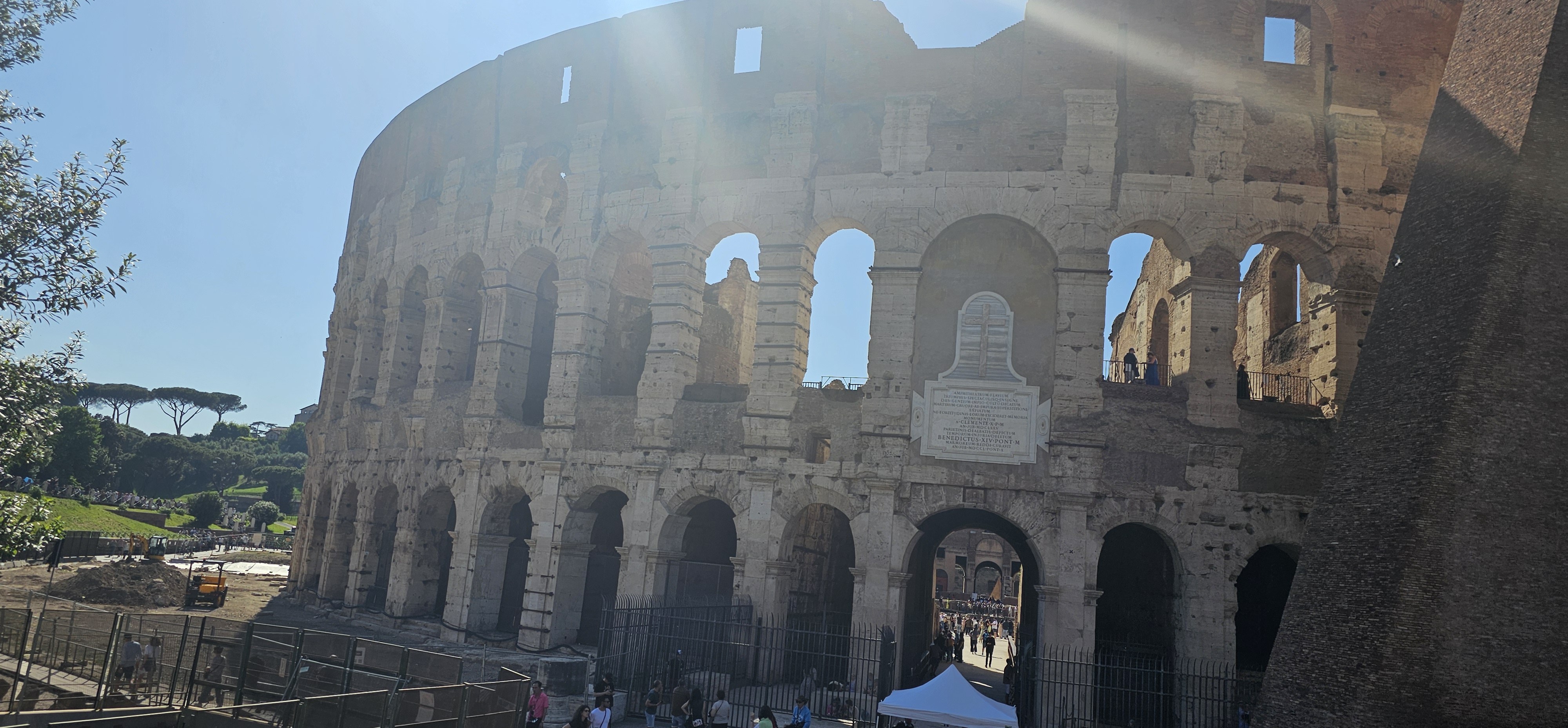
Day 2 in Rome, we started with catching the metro from Ottaviano to Barberini. And because we slept in, we were already in with the crowd at Trevi Fountain at 10amish. Unlike the Vatican City/Prati region, we managed to hit all the main tourist attractions in Rome despite losing our way often and having to ask for directions. We had a bland tasting seafood aka calamari salad for lunch at Piazza Navona. Later, we had a time mix up and thought we were late for our dinner appointment near the Colosseum at 6:30pm when it was only 3:13pm in Rome. That meant we sat around for a long stretch of time near the eating strip nearby- we had gelato, soft drink etc. The dinner we had was at Trattoria Luzzi. Mum had the carbonara while I had a baked sea bass/bream. Mum didn’t particularly like the carbonara- it was tasteless without the bacon inside and too salty with. My fish was okay but not spectacular. After dinner, we went to the Colosseum to take pictures and only Mum had a picture of the full Colosseum, I only had a pic of me with a corner of the Colosseum which was not identifiable as the Colosseum. But ah well, not that I’m an enthusiast of having pics of myself with all the landmarks. 

Temporary rest from Blogging

I just came back from an almost month-long vacation from Europe hoping to have a long sleep session to catch up with jet lag and recovering from the cold, only to find… that our house has been broken into. 

As a result, I am calling for rest from blogging for the month of June so that I can recuperate. But worry not. There is plenty to share on the trip after that. Stay tuned!

Bye… for now. 

European travel from Australia: currency conversion and travel cards

There are many other resources on these topics and feel free to browse around for a wider range of opinions but what I did was to use S Money to do my currency conversion (I used Travelex for the New Zealand but S Money is offering me a much better conversion rate, S Money is not able to offer me a single trip conversion like Travelex and hence takes a higher service charge compared to Travelex for the same amount of foreign currency needed but the better exchange rate covers it and for a rough idea we are talking about 0.6 compared 0.58x on any given day between S Money and Travelex. The other consideration is that Travelex has way more branches and so you can easily get to a place close by whereas at the end of last year when I started with S Money they only had the single branch on Spencer Street in the city in Melbourne but now it has about 4 locations in Melbourne now and I think they have similar expansions interstate too). 

For a travel card, I elected to go with the Suncorp Everyday account because that’s the only non credit card that offers Internet banking for me. I could have elected to go with a credit card and I tried applying for the Latitude Platinum Mastercard because it offered free wifi as a perk but I gave up because once I saved my application and tried to resume I just couldn’t get back in. When I rang customer service, I was told that basically there was only one number for all applicants to connect to and that you just had to try logging onto the system every 15-20 minutes. I tried that about 5 or 6 times and being impatient in nature, I just gave up on it. That and Mum continuously worrying me about applying for a credit card and the interest rate charges involved. In practice, I’ve found out that while the Suncorp does not charge the visa 3% fee for transacting with overseas companies, if the other side charges it (eg. Swiss railway company), then you still incur the 3% but ah well, it still beats the bank card of our Big 4 bank that automatically slaps on the 3% charge on. 

Moonlake’s Approach to Writing Exercises

Those who followed my blog for a while should probably know that I’m a whimsical person when it comes to reading and writing. So that’s my approach to writing exercises if I have to sum it up with one word. 

I bounce around with writing exercises in that if I grow tired of one, I switch to another. I tend to not follow other people’s ideas that much, with the vague notion that I’m using them to strengthen my weak spots. 

My current writing exercises include the following:

  • The omniscient exercise that I blogged about before where I’m translating an omniscient online novel from Chinese to English 
  • What I call “no obligation” where I made up or sourced random prompts to start off on a story that I give myself absolutely no obligation to finish (and I don’t think I had finished any single story I started for this exercise) which has now evolved into a long lists of remembered moments/recent happenings under the headings “Moments in Time” 
  • Juxtaposition, an exercise I revived where I used an Excel sheet of 10 columns of words I handpicked, so that I’m generating one random idea per day that might or might not be useable for anything
  • 5 For today, an idea from an article that I read as one of the free online writing/self-care courses I did, where I recorded 5 thoughts I had for the day. Currently, it often overlaps with the no obligation “Moments in Time” exercise as they both use the same base for inspiration. I did have a new prompt sitting there for the no obligation exercise but somehow I just kept writing down moments in time instead of starting a new story with that prompt. Not sure if it is lethargy or what. 

In the past, I had actually done the following writing exercises:

  • The action scenes exercise which leverages on my movie spell. Basically, I was fictionising particular action scenes in movies that I had seen recently. When I stopped with this exercise, I compiled a table of contents grouping scenes by content (running scenes, fighting scenes etc.) so that if I ever became stuck with action scenes, I now have a kind of reference guide where I can copy and paste passages to use as starting points
  • The alternate scene exercise where I was using moments out of Under Heaven by Guy Gavriel Kay and rewrite it alternately in first person and third person perspective. Why I used this particular work was simply because I was analysing it at the moment, mistakenly believing that it was written in omniscient form but it turned out to be written in third person limited with an omniscient narrator voice
  • The empathy exercise that I took off some source that I had forgotten about now, where I pegged that I was writing from a Chinese point of view in ancient times. Then on each day I would create a character that has three components: gender, occupation, descriptor. Some examples were: A decadent Emperor; A sensitive female prostitute; A scholar with a fixated way of thinking etc. I would write 100 words or so showcasing a given character   
  • The sensory details exercise, aiming to increase my capability to make concrete sensory details. I would come up with three adjectives under each of the six senses of sight, sound, smell, taste, touch and perception at a time. On each day, I pick up two senses and come up with two short paragraphs on each adjective
  • The sun, moon and star exercise: I’ve just noticed that I’m drawn to the three heavenly bodies and so I basically cycle through them and write a short paragraph about each every day. I think it shortly dies out because after a while, it is very hard to be original

And that’s it in terms of writing exercises. Until next time.

Remarkable Women in Ancient China (21)- Yoshiko Kawashima

Who is she:

  • A renowned female spy of Manchurian descent, who spied for the Japanese during the Second Sino-Japanese war that is part of World War 2

Notable Life Events:

  • Born in 1907, 4 years before the Qing dynasty was overthrew, as Aisin Gioro Xianyu, a Manchurian princess born to a concubine mother 
  • In 1915, she was given up for adoption at the age of 8 to her father’s friend, a Japanese espionage agent and mercenary adventurer, who took her to Japan and gave her the name she was better known as, Yoshiko Kawashima
  • When she was 15, her father died and her mother followed the Manchurian tradition of committing suicide as a concubine. At the age of 17, her adoptive father raped and later continued to abuse her 
  • On 22 November 1925 (aged 18), she proclaimed of her decision to cease to exist as a woman forever and started dressing in men’s clothes as well as changing her hairstyle to a crew cut
  • When she was 20, she was arranged by her brother and adoptive father to marry a Mongolian prince (the Manchurian dynasty was really founded on a Manchurian-Mongolian alliance) but she divorced three years later. Afterwards, she seemed to have led a decadent life where she had lovers of both genders
  • Her espionage career seemed to start with meeting the intelligence officer Ryukichi Tanaka in Shanghai and subsequently moving in with him 
  • Due to a cordial relationship with Puyi, the last Emperor of the Qing dynasty, who saw her as a member of the Imperial family (she was his distant cousin), she was able to persuade him to re-ascend the throne as the figurehead ruler of Manchukuo, a puppet state created by the Japanese for Manchuria based in the city of Harbin bordering Russia
  • She was arrested in Beijing in 1945, charged with treason in 1947 and executed in 1948 

Moonlake’s thoughts on her: 

I think this is a woman that is worthy of being cast as a female lead for sure (there was definitely a HK movie about her where she was played by Anita Mui): she has outward charm and she knows what she is doing. 

English Reference: https://en.wikipedia.org/wiki/Yoshiko _Kawashima

Upcoming European trip in May- planning details and resources

This is not a travel blog per se but because I always obsessively plan my trips down to literally minutiae, I might as well collate the various bits of knowledge I’ve gathered for newbies like me. 

Firstly, for itineraries, I’ve found the following sites very useful as templates and I can adapt them for my own personal needs:

www.earthtrekkers.com

Among them, earthtrekkers is usually where I start off since it has a broad coverage for 10 day trips around the world. Then I would do separate Google searches for “x days in [City name]” and  the other two often come up. 

If you are traveling or plan to travel around European cities via the train, https://www.seat61.com/ is the go-to comprehensive guide on train travel around the world. For my upcoming trip across three European countries- Italy, Switzerland and France, I ended up buying my train tickets three different ways for each country despite there being two aggregate ticket resellers and here’s why:

  • I was originally planning to buy Italian and French tickets all together through one resellers-RailEurope which only charges a flat fee of $8 Euro for a single cart of purchase which trumps Trainline which charges 3% of each single ticket bought through them. However, the Italian train companies only allow you to hold tickets for 10-15 minutes and when you also have to pick seats and choose between alternative times, I just found it an entirely hopeless endeavour to be able to buy 20 tickets all in one go through RailEurope. 
  • So change of plans: through research I found out that there are only two train operators in Italy: the state-owned Trenitalia which operates every single train line in Italy and the private company Italo that only runs lines between major cities. What I did was basically just open up the two train websites on different tabs and run a search on the day I want to travel. Personally, I think the Italo website is easier to use for English speakers (no surprise, apparently it’s operated by a US conglomerate) but the Trenitalia can be switched to English on the top right-side as well. The only caveat is that you have to know the station names in Italian but that’s easy because a part of my trip planning always leads to search for “from location x to location y” which takes me to Rome2Rio.com which will show you different methods of traveling between the two locations, the time it takes, how long and schedules etc. And there I can easily find out about station names in Italian or whatever local languages. This way, I was able to book my Italian tickets one by one without the short time limit hanging over my head. Also, instead of the black-box interaction on RailEurope where I always feel inclined to book the cheapest tickets available I can easily compare across different ticket categories in terms of conditions (whether you can change the time and day of the train you take, whether tickets are refundable etc.) 
  • I tried to replicate the same on the French side where there is only a single operator but then the SNCF site keeps freezing whenever I try to buy with my visa debit card. I tried to get in touch with them and the only means seemed to be through Facebook Messenger without any response. Then the GM of my gaming group told me of his experience in another European country which made me remember that I read somewhere that the French rail company’s website acted funny with foreign credit card purchases so back to RailEurope I went with all my French train tickets. This time around it works fine because the French side does allow you to hold a ticket for much longer. The shortest was 15 minutes for a trip between Paris and Versailles according to my recollections but most of the other tickets can be held for about 1 hour and above and there’s no need to select seats. 
  • On the Swiss side, all I did was buy a half fare card for a month (we are only staying in Switzerland for 9 days but it’s still a cheaper option compared to the 10 day Swiss pass, especially since we are not visiting any museums) and the Daily Saver Pass for one day where I knew I would be traveling intensively along the Interlaken-Lauterbrunnen-Murren-Stechelberg route. I’m not purchasing any other tickets online because it always takes a 3% foreign transaction fee on their website even though I’ve got a visa debit card that doesn’t charge the fee on my end. Plus, there is absolutely no need to reserve seats and there is no cost advantage to buying individual point to point tickets in advance. 

As per usual, I use booking.com for hotels because their website is easy to use for a search. But remember to set currency to property currency so that they don’t take a cut out of you for currency conversion. I’m not taking so many day tours this time around as for my New Zealand trip (only one in Venice) and I’m sticking to Viator.com. And just one advice of caution on European day trips: always search out whether you can DIY the same itinerary as a Viator day trip on your own. Back when I first started my European trip planning, I was going to sign up to 5 or 6 day tours but in the end only the Venice one was left because the other ones were either too expensive or could be completely or partially replicated with train travel between cities. I kept with the Venice one just for the gondola ride because research says that otherwise you have to negotiate rates with the gondolier yourself and I find that a major hassle. 

The Reading Experience: has Writing Changed it?

For me, the short answer is no. 

The long answer is well, writing could have changed it in a theoretical sense. Because, like a mechanic, a totally valid way for learning is to take a piece of writing apart and try to reverse engineer something of your own. In that sense, as a writer, one way to approach reading is to take what you read apart and analyse it so that you can internalise whatever craft element you are interested in. 

For me personally, I just enjoy reading too much to ever adopt that mindset in everything I read. So my approach to book analysis is basically the following: I would handpick certain books to analyse. But the first time I ever read it is still as a pure reader so that I can wring whatever enjoyment I can get out of it first. And then I would go back and read the book the second time around and start my analytical phase there. And I might do iterations, if I want to, for different aspects. 

Has writing changed the reading experience for you, my fellow writers? I would be keen to learn of other different answers to my own if you are willing to share in comments. 

Chinese Lore- a selection of mythical fauna (19)

Xiao

Physical Description:

A monkey-like bird with two pairs of wings, a single eye and a dog-like tail.

Special Properties:

The sound of its call is like that of magpies. Consuming its meat cures stomachaches and diarrhea.


Yong Yong Fish

Physical Description:

A fish that looks like a yak.

Special Properties:

The sound it makes is like those of pigs.


Ji Fish

Physical Description:

A fish with red scales.

Special Properties:

The sound it makes is like humans telling someone off. Consuming its meat cures bad body odours.

Translation Quirks:

It is easy for a mistaken translation to arise that consuming its meat cures one of pride/arrogance.


Hui

Physical Description:

An antelope-like creature with four horns and a horse-like tail and toes growing out of its heels.

Special Properties:

The sound it makes is like its name. It is good at turning circles and dancing.

A Changing Relationship with Cozy Mystery

I feel like I have said this N times already but sub-genre is a concept that comes slowly to me. Hence, I never quite grasped the concept of cozy mystery until recently and my first time experience didn’t amount to anything even close to liking. I felt the pacing was too slow and there was no element in particular that I liked. 

It’s a bit hard to talk about a definitive work that changed this but perhaps it started with the Miss Marple series by Agatha Christie. All right, so back in her days there was no such thing as a cozy mystery and I’m pretty sure it won’t be classified under cozy mystery now (I just checked Amazon to make sure and yep, I’m not wrong). 

For contemporaries, I don’t remember particular author names but I did read a couple just last year or early this year. I can’t say what finally made me click with them other than they are good light reading. I mean, it used to be that all mysteries were ultimately light reading for me. But in recent years, I feel like that is less the case given my penchant for staying away from the epic fantasy subgenre (I’ve already blogged about it earlier in Competition between Reading and Writing Fantasy) and there is an overall shift towards making series more standalone nowadays that makes the distinction between serious and light reading material almost redundant. Of course, there is always a mental shift that now allows me to sample book 1 of a series and then discontinue with it at whim. 

And that’s it as far as cozy mystery and me is concerned. I haven’t actually put it on my favourite or comfy list or whatever but I’m not averse to picking up books from this sub-genre as I encounter them. As it will be always be with me, it’s entirely up to the backcover blurb or summary on my library’s catalogue. 

Writing Scenes

Those who have been following my blog would probably know that I firmly belong to the planner school in terms of a writer. This is to say that I outline each scene rather than write them on-the-go. But how does my process look like after that, you might wonder. This is what this post is all about. 

First up, I have to say that my process is not standard across all scenes. I would dearly like to find a template that I can apply to every scene just because I find comfort in routines. But sadly in practice I can never do that. The easiest scenes are pretty much as I’ve outlined. I can easily convert my traditional outlines into a scene with minimal effort. The task itself is like snapping my fingers, just like that. Through personal experience, I feel like I am already past such scenes. My personal grasp on the WIP seems to be strongest in Act 1 and then it progressively slips. 

The next level is where I use what I call pre-writing extensively. There will be large sections where I’m asking myself a bunch of questions about the scene and answering them all in one go. Across consecutive days, I might even go over the same scene several times all in this ‘behind the scenes’. There was this scene where I spent about two weeks on it and I had written 3000+ in total but when I took out all the pre-writing it was a scene of about 500 words.   

For the most difficult scenes, mostly I’m playing doctor to see what’s holding me up. Ever since the last couple of decimal drafts, I’ve started to work with a set dot point on all the scenes that I feel I can’t quite get into. In the first go, they only include 2 dot points:

  • What’s the main events in this scene? Since I’m a event-centric person I usually have little difficulty with this and so I naturally use this as my starting point. 
  • What do I need to do to advance this scene: This is just a place for me to brainstorm what do I think the issues 

After this, I usually leave this scene for the next round of iteration (to be honest, I stopped even incrementing along my decimal drafts. I’m still on draft 0.83 and I think I was on it last year. What I’m basically doing is going through my rough draft time and again picking out which scenes I still need to work on and then I will give each scene a week or two at most or sometimes just days and then move on at whim. 

Then in the second iteration over the same scene, I might extend the dot point list on the scene with extra dot points including:

  • What is its narrative purpose?
  • What are the main character goals?
  • What is at stake for the character? 
  • What are the Conflict/Impediment to Goal?
  • What is the Outcome? 
  • What is the Reaction? 
  • What is the Dilemma?
  • What is the Decision? 
  • What are the opening and closing emotions in this scene

For those not familiar with it, this is from the GCORDD framework from K.M. Weiland’s Outlining your Novel: Map your Way to Success supplemented with other stuff. This framework basically breaks down each scene into Goal, Conflict, Outcome, Reaction, Dilemma and Decision (not each scene has to have all elements but it’s just the most comprehensive framework of breaking down a scene into elements). 

At one point, I also had a different set of template from Robert McKee’s Story: Substance, Structure, Style and the Principles of Screenwriting where he conceptualies each scene as an interplay between the character and external parties (another person or the environment) in the sense of the external thing thwarting the character’s expectation and the character’s subsequent reaction to such thwarting and it was this framework that finally clicked with me and made me ‘get’ the concept of beats. So for a while I was summarising a scene as a series of dot points like the following:

  • Character x expects….
  • But this happens….
  • So character x does…
  • Character x expects…

As you can see, I can keep cycling between the three elements until the end of the scene. 

Now, the problem with this framework is that my mind has to be at a pretty micro level with the character and I am not always able to get in there. So lately, I’ve been using the GCORDD framework. 

And that’s my share on writing scenes today. Feel free to ping me via comments if anything about my methods interests you.