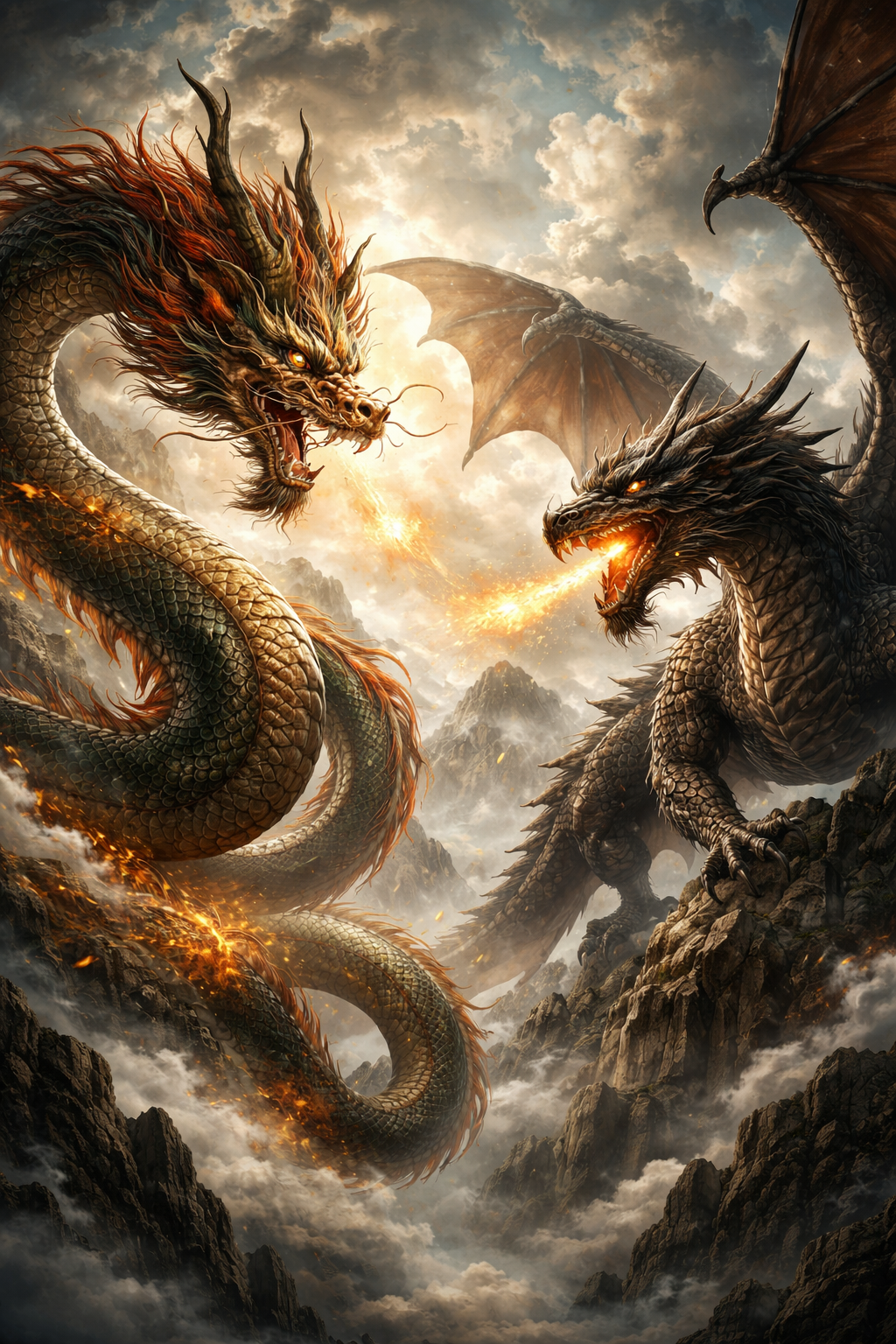
I am starting a new post series that compares elements of Chinese fantasy versus Western fantasy. For the very first post, I am going to focus on dragons.
When we say “dragon”, we are often assuming a shared idea. But that assumption doesn’t really hold once you compare Chinese and Western contexts.
Broadly speaking, the Chinese dragon is not a monster. It is closer to a force of nature. The Western dragon, on the other hand, is typically framed as something to be fought.
The Chinese dragon: Regulator, Not Monster
In the Chinese context, dragons are tied to water—rainfall, rivers, seas, and seasonal cycles. This already places them in a very different role. They are not sitting on treasure; they are part of how the natural world functions.
Because of this, they are not inherently hostile. They can bring floods or drought, but that is less about malice and more about imbalance. There is an implicit idea that human behaviour, ritual, and cosmic order are connected, so the dragon becomes something to respond to, rather than something to defeat.
This also carries into political symbolism. The dragon is associated with the emperor, not because it is fearsome, but because it represents alignment with Heaven and the ability to maintain order.
So the same figure moves quite easily between nature and governance. It doesn’t change role; it stays as a kind of regulator.
The Western Dragon: The Enemy
The Western dragon is positioned very differently.
It is usually:
- territorial
- destructive
- associated with treasure hoarding
More importantly, it exists as an obstacle. It sits outside the normal order of things and disrupts it.
So the narrative pattern becomes fairly straightforward: the hero encounters the dragon, defeats it, and restores order.
A Difference on Morality
There is also a difference in how morality is framed.
Western dragons tend to symbolise greed or excess. They represent something that has gone wrong and needs to be removed.
Chinese dragons don’t really carry that same moral weight. If something goes wrong, it is more likely understood as imbalance rather than corruption.
So while both are called “dragons”, they operate on very different assumptions.
In one case, power is something to be brought back into balance. In the other, it is something to be overcome.
That difference is small on the surface, but it shapes how entire systems of mythology and fantasy are structured.
I have kept this fairly broad, but it should give a basic frame for how the same creature can function so differently across cultures. If you want to dig into any part of this further, feel free to comment.

